

Getting accepted into a university abroad is exciting. Then come the bills. You have the tuition fees, accommodation, flights, visa expenses, health insurance, and dozens of smaller purchases that barely get a mention in university brochures.
Perhaps the biggest surprise is how unevenly expenses arrive. Your first month can cost three times as much as an ordinary month. Another large payment arrives when the second semester begins. Even during the summer break, you may still owe rent.
So how much money should you actually prepare? To make the numbers useful, we will follow a first-year international student in Germany, where many public university programs have no tuition fees. The same budgeting method works for other destinations, although the amounts will differ.
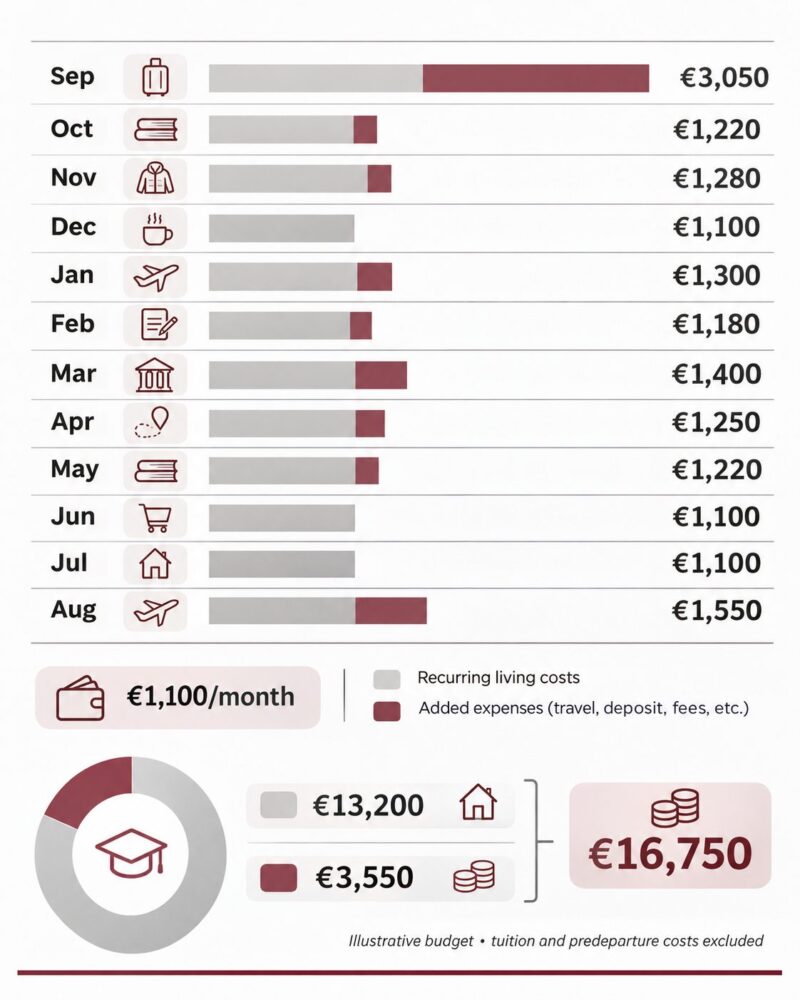
First-Year Study Abroad Costs, Month by Month
The German Academic Exchange Service (DAAD) estimates that students in Germany generally need €900 to €1,200 per month for living expenses, depending on their location and circumstances.
Our example uses a monthly living budget of €1,100 for a student renting a room in a shared apartment. The student begins classes in September, pays two semester contributions of €300 each, and covers the cost of moving abroad without a scholarship.
| Month | Additional Expenses | Estimated Total |
| September | Flight, housing deposit, household essentials, first semester contribution | €3,050 |
| October | Textbooks and course supplies | €1,220 |
| November | Winter clothing | €1,280 |
| December | Ordinary monthly expenses | €1,100 |
| January | Optional holiday travel | €1,300 |
| February | Exam preparation and printing | €1,180 |
| March | Second semester contribution | €1,400 |
| April | Optional weekend trip | €1,250 |
| May | Additional course materials | €1,220 |
| June | Ordinary monthly expenses | €1,100 |
| July | Ordinary monthly expenses | €1,100 |
| August | Optional flight home | €1,550 |
| Total First-Year Cash Requirement | €16,750 | |
Note: All amounts are illustrative budgeting assumptions, not quoted university prices. Every month includes €1,100 in living expenses. September includes a €450 flight, €900 refundable housing deposit, €300 in household purchases, and a €300 semester contribution. Tuition, visa applications, language tests, and expenses incurred before arrival are excluded. Optional trips can be removed.
Of the €16,750 in this example, €13,200 covers ordinary living expenses. Another €3,550 covers irregular purchases and payments, including the refundable deposit. The deposit remains tied up until the landlord returns it, so you still need the money when you move in.
Before Departure, You May Already Have Spent Hundreds
Your first bill might arrive months before your flight.
University applications can involve processing fees, certified document translations, language tests, and the cost of sending academic records. Depending on your citizenship and destination, you may also need a visa or residence permit.
Then comes accommodation. Some student residences require advance payments, and private landlords commonly request a security deposit before handing over the keys.
Germany allows rental deposits of up to three months of basic rent, excluding additional service charges. The deposit is normally refundable, provided your tenancy obligations have been met. Germany’s official housing information explains what tenants should expect when arranging accommodation.
Another expense can look enormous on paper without being a separate fee. Certain international students must demonstrate that they have sufficient financial resources to obtain a German study visa. A blocked bank account is one way to provide that proof.
Money placed into the account is intended to cover living costs during your studies. It should not be added again to your annual budget as if it were an extra university charge. Account setup and administration fees, however, are separate expenses.
Month One Is Usually the Most Expensive
Even with accommodation secured, you may arrive to find an empty kitchen, an unfamiliar transport system, and a shopping list longer than expected.
Bedding, towels, kitchen utensils, cleaning products, and basic groceries can consume several hundred euros. Furnished student rooms do not always include everything needed for daily living.
Try to arrive with enough money for your first rent payment, transport, groceries, and any outstanding deposit. Do not assume that a scholarship payment or bank transfer will become available on the day you land.
Keep receipts for purchases made during your first week. They will show which expenses were related to moving in and which will continue every month.
What Does an Ordinary Month Actually Cost?
Once the initial purchases are complete, expenses become easier to predict. In our German example, the €1,100 monthly budget is divided as follows.
| Expense | Monthly Budget |
| Shared accommodation and utilities | €520 |
| Groceries and toiletries | €230 |
| Health insurance | €146 |
| Local transportation | €45 |
| Mobile phone | €20 |
| Study expenses, household purchases, and personal spending | €139 |
| Total | €1,100 |
Accommodation is the largest expense here. Saving €100 on monthly rent would reduce the annual housing bill by €1,200. That is a substantial difference for a student funding a degree through savings or family support.
Compare the full monthly rental cost, including heating and utilities, rather than the advertised basic rent alone. Internet and electricity may also be billed separately.
Grocery costs depend on how much you cook. Preparing meals at home and using university cafeterias can help keep food spending predictable. Frequent takeaway orders, restaurant meals, and convenience store purchases can push the total beyond your plan.
Health Insurance Deserves Its Own Budget Line

Medical coverage is one of the expenses international students need to settle before enrollment. Requirements differ between countries, and an existing policy from home may not be accepted by the university or immigration authorities.
Germany requires students to have recognized health insurance. For example, German statutory insurer TK lists a combined monthly health and long-term care contribution of €146.29 in 2026 for a student aged 23 or older without children.
Students eligible for private coverage need to compare premiums, deductibles, benefits, and the consequences of changing insurance systems.
German insurance specialist Audelio explains the costs and eligibility considerations for private insurance for students, including the differences between private policies and statutory health coverage.
A cheaper monthly premium does not automatically mean lower overall expenses. Check what happens if you need medical treatment, whether you must pay bills before receiving reimbursement, and how the policy affects your insurance choices later.
Some international students already have insurance that Germany recognizes. Others need a new policy. Confirm your individual status before purchasing coverage, especially if you intend to work part-time during your studies.
Month Seven Brings Another University Bill
By the middle of the academic year, you may feel comfortable with your spending. Your rent is predictable, you know where to buy groceries, and the expensive move-in purchases are behind you.
Then the second semester begins.
German universities charge a semester contribution that is separate from tuition. DAAD reports that the contribution varies by institution and pays for services such as student representation and, at some universities, public transportation.
In our example, another €300 is due in March. For someone living on a fixed monthly allowance, paying the entire amount at once can be difficult.
One solution is to reserve €50 every month during the preceding semester. After six months, the next €300 payment will already be covered.
The same approach works for textbooks, annual software subscriptions, and other expenses that arrive only once or twice a year.
Summer Break Is Not Necessarily a Break From Expenses

Students sometimes assume they will spend much less during the summer because classes have finished.
Rent is the first reason that assumption can fail. A twelve-month housing contract continues even when lectures stop. You may also have to pay for utilities, insurance, and a mobile plan during a visit home.
Travel introduces another expense. A flight booked close to departure can consume money originally reserved for groceries or the next semester, while even a weekend trip can introduce extra accommodation, transportation, and entertainment costs.
If you plan to leave your accommodation permanently, check your notice period well ahead of time. A late cancellation can leave you responsible for additional rent.
Students staying abroad for summer work or internships should also check any related insurance, transportation, and housing requirements before accepting a position.
Why Costs Look Different in Other Countries
Germany provides a useful example, but international education expenses vary considerably.
In the United Kingdom, students applying for a visa must demonstrate that they can cover course fees and a specified amount for living costs. Current UK government requirements set the living funds requirement at £1,529 per month in London or £1,171 outside London, for up to nine months.
Those figures are visa financial requirements, not personalized estimates of everything a student will spend. Tuition and other expenses must be considered separately.
For universities in the United States, tuition and mandatory institutional fees can make up a much larger share of the budget. Housing arrangements, meal plans, and health insurance charges also differ between institutions.
Students considering Germany can also review practical Munich travel tips to see how local transportation, accommodation choices, and everyday spending habits can influence their budget.

How Much Should You Save Before Studying Abroad?
Begin with the university’s official fee schedule and the housing arrangement you actually intend to use. A shared room, student residence, and private studio apartment can produce very different annual totals.
Next, calculate twelve months of living expenses, even if your academic calendar includes a shorter teaching period. Add the cost of two semesters, moving expenses, flights, required documents, and insurance not already included in your monthly budget.
Keep a separate emergency fund if your financial circumstances allow it. Unexpected travel, replacing a laptop, or temporarily changing accommodation can be expensive when your savings are held in another currency or your monthly allowance is fixed.
Our German example comes to €16,750 in first-year cash requirements, including optional travel and a refundable housing deposit, but excluding tuition and several possible predeparture costs. A scholarship, lower rent, or a shorter stay could reduce the total considerably.
Before paying any nonrefundable deposit or booking a flight, compare your available funds with the dates on which major bills are due. The most useful study abroad budget is one that tells you not only how much the year will cost, but also how much money needs to be available each month.